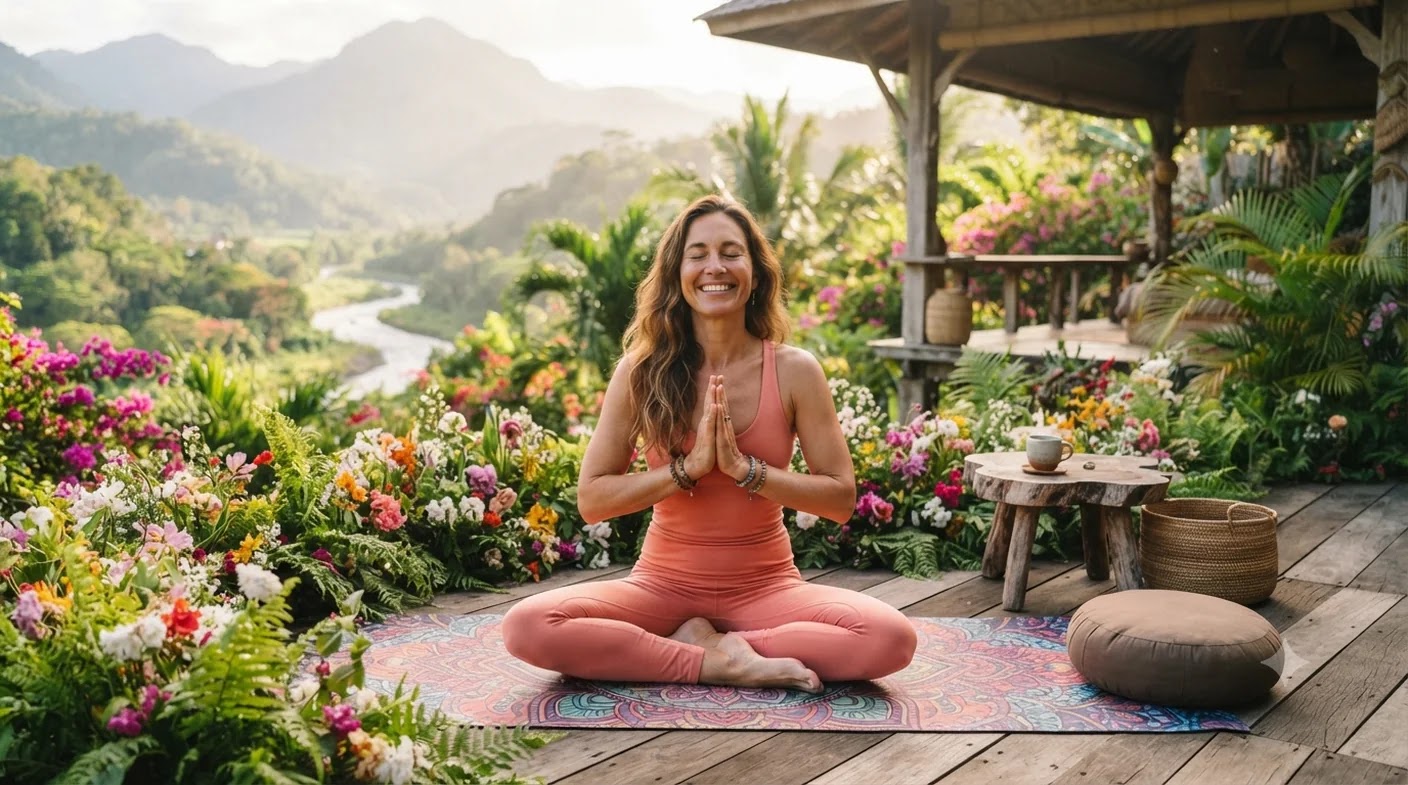
 Yoga and Meditation Practice is more than physical movement; it is an opportunity to reconnect with the body, breath, and present moment.
How Your Environment Shapes the Connection Between Body, Mind, and Well-Being
In a World Where Calm Has Become a Rare Luxury
In a world where calm has become a rare luxury and training the mind to remain present is more challenging than ever, people are increasingly searching for ways to reconnect with themselves.
Between endless notifications, constant stimulation, demanding schedules, and the pressure of modern life, many individuals feel disconnected from their own bodies. They move through the day, yet rarely pause to notice their breath. They experience stress, yet often fail to recognize how deeply it manifests physically through muscle tension, fatigue, poor posture, and mental exhaustion.
This search for reconnection is one of the reasons yoga continues to resonate with millions of people around the world.
At its heart, yoga is not simply a form of exercise. It is a practice of awareness. It is an invitation to slow down, observe, breathe, and experience the relationship between body, mind, and environment with greater clarity.
While movement is certainly part of yoga, the deeper experience often emerges from something more subtle: attention.
Attention to breath.
Attention to sensation.
Attention to the present moment.
And perhaps most importantly, attention to ourselves.
Yoga and Meditation Practice: Beyond Physical Movement
In many Western cultures, yoga is often associated with flexibility, balance, and physical postures.
While these elements are valuable, traditional yoga has always been about more than physical performance.
Yoga encourages a state of integration—bringing together movement, breathing, awareness, and intentional presence.
A successful yoga session is not necessarily the one where a person achieves the most difficult posture.
Instead, it may be the session where they become more aware of:
- How their body feels
- Where they hold tension
- How they breathe under challenge
- How their thoughts influence their physical experience
- How their environment affects their state of mind
This awareness creates a unique opportunity to cultivate a healthier relationship with the body.
Rather than forcing performance, yoga teaches observation.
Rather than competition, it encourages curiosity.
Rather than perfection, it invites presence.
The Breath: The Bridge Between Body and Mind
If movement is the visible part of yoga, breath is its invisible foundation.
Breathing occurs automatically throughout life, yet it is one of the few bodily functions that can also be consciously guided.
This makes the breath a powerful link between physiological processes and mental experience.
When people experience stress, their breathing often becomes shallow, rapid, or irregular.
When they feel calm, breathing tends to become slower and more rhythmic.
Yoga encourages practitioners to pay attention to this connection.
Through mindful breathing practices, individuals learn to:
- Observe their physical state
- Improve body awareness
- Develop concentration
- Create moments of stillness within busy days
- Enhance the quality of movement
Research from the National Center for Complementary and Integrative Health (NCCIH) suggests that breathing practices, meditation, and yoga may support stress management and overall well-being. While breathing exercises are not a substitute for medical care, they can become valuable tools within a broader wellness routine.
In yoga, the breath is not simply accompanying movement.
It guides movement.
Each inhale creates space.
Each exhale encourages release.
And over time, the simple act of paying attention to breathing can become a daily practice in returning to the present moment.
A consistent Yoga and Meditation Practice allows individuals to explore the relationship between conscious breathing, physical movement, and mental awareness.
What Happens in the Brain During Yoga?
One of the most fascinating aspects of yoga is the way it combines physical movement with focused attention.
Throughout the day, the human mind naturally shifts between memories of the past, concerns about the future, and countless external distractions.
Yoga gently interrupts this pattern.
When attention is directed toward posture, breathing, balance, and sensation, awareness becomes anchored in the present experience.
Researchers studying meditation and mindfulness, including findings discussed by Harvard Health Publishing, have observed that these practices may influence areas of the brain associated with attention, emotional regulation, self-awareness, and cognitive flexibility.
This may help explain why many practitioners describe feeling:
- Mentally clearer
- More focused
- Less overwhelmed
- More connected to themselves
Importantly, yoga does not aim to eliminate thoughts.
Instead, it teaches people how to observe thoughts without immediately reacting to them.
This subtle shift can transform the experience of everyday life.
The Conversation Between Muscles and the Nervous System
Movement is often viewed as a muscular activity.
In reality, every movement is a conversation between muscles, joints, nerves, and the brain.
When you stand in a balancing posture, your body continuously gathers information from:
- The soles of your feet
- Your ankles
- Your hips
- Your spine
- Your visual system
- Your inner ear
The nervous system processes this information almost instantly and makes countless adjustments to maintain stability.
Yoga enhances awareness of these processes.
Rather than moving automatically, practitioners learn to move intentionally.
This increased body awareness—often referred to as proprioception—can support better movement patterns, posture, coordination, and balance.
The goal is not simply stronger muscles.
The goal is a more intelligent relationship between the body and the mind.
Yoga for Different Body Needs
Every body is different.
People come to yoga for many reasons:
- Mobility
- Strength
- Stress management
- Balance
- Recovery from inactivity
- Improved body awareness
- General well-being
Over the years, specialised approaches have emerged that focus on specific physical needs.
Pelvic Health and Women’s Well-Being
Certain yoga practices emphasise gentle movement, breathing, posture, and awareness of the pelvic region.
These practices may help individuals improve mobility, posture, body awareness, and comfort around the hips and pelvis.
For women, mindful movement and breathing can become valuable tools for developing a stronger connection with the body throughout different stages of life.
However, yoga should not be considered a treatment for gynaecological conditions, and medical concerns should always be discussed with qualified healthcare professionals.
Arthritis and Joint Mobility
Many people with arthritis seek forms of movement that are gentle, adaptable, and sustainable.
Research suggests that appropriately modified yoga programmes may help support flexibility, balance, mobility, and quality of life in some individuals living with arthritis.
The emphasis should always remain on safe movement rather than pushing beyond comfortable limits.
Flat Feet and Foot Awareness
Modern lifestyles often reduce awareness of the feet despite their critical role in posture and movement.
Many yoga postures encourage:
- Foot strength
- Balance
- Weight distribution awareness
- Ankle stability
These practices may support overall foot function and postural awareness.
Spinal Alignment and Posture
Long hours of sitting can contribute to muscular imbalances and poor posture.
Yoga frequently incorporates movements that encourage awareness of:
- Spinal positioning
- Core engagement
- Shoulder alignment
- Mobility throughout the spine
For some individuals, this increased awareness may support healthier movement habits throughout daily life.
However, structural spinal conditions require professional assessment and should not rely solely on exercise interventions.
Why Environment Matters More Than Most People Realise
Yoga and Meditation Practice begins within.
Yet the environment around us can either support or distract from the experience.
The human nervous system constantly responds to sensory information.
Light.
Sound.
Temperature.
Texture.
Space.
Even subtle environmental details can influence how easily we settle into a state of focus.
A thoughtfully designed practice space does not create peace.
But it can reduce obstacles to peace.
Many practitioners find that simple environments encourage deeper concentration:
- Natural light
- Fresh air
- Minimal visual clutter
- Soft colours
- Natural materials
- Comfortable temperatures
The goal is not perfection.
The goal is creating a space that allows attention to turn inward.
End of Part 1
In Part 2, we will cover:
- The role of air, nature, and sensory experience
- Why touch matters in yoga and meditation
- Natural textiles and skin comfort
- Yoga towels beyond function
- The importance of a yoga mat
- The Lomyna Ritual after practice
- Slow living and mindful recovery
- Conclusion and Lomyna Perspective
This continuation is essential because it is where the article naturally connects yoga, textiles, towels, mindful living, and the Lomyna philosophy without becoming promotional.
A meaningful Yoga and Meditation Practice is a journey of returning to balance, awareness, and connection.
part2:
The Role of Air, Touch, and Ritual in a Meaningful Yoga Practice
The Role of Air and Natural Surroundings
Breath is often described as the foundation of yoga, yet the quality of the air we breathe is rarely discussed.
Every breath is an exchange between the body and the environment. While yoga is possible almost anywhere, many practitioners notice that their experience changes depending on where they practice. A quiet room with fresh air may encourage deeper concentration, while a crowded or poorly ventilated environment can make breathing feel more effortful.
Research in environmental psychology suggests that natural surroundings can influence mood, attention, and perceived stress levels. This may help explain why many people feel more grounded when practicing near a window, in a garden, beneath trees, or in spaces that incorporate natural elements.
Nature does not create mindfulness for us. Rather, it often reduces distractions, making it easier to notice what is already present: the rhythm of breathing, the sensations of movement, and the subtle signals of the body.
Whether indoors or outdoors, a supportive practice space is less about perfection and more about creating conditions that allow attention to settle.
Why Touch Matters More Than We Think
Among the five senses, touch is often the least discussed in conversations about wellness. Yet it is one of the earliest ways humans experience the world.
The skin is the body’s largest organ and serves as a constant source of information. Temperature, texture, pressure, and movement are continuously communicated through millions of sensory receptors.
During yoga and meditation, attention is often directed inward, making these sensory signals more noticeable.
The feeling of bare feet against a mat.
The texture of fabric against the skin.
The warmth of sunlight on the shoulders.
The sensation of the breath moving through the chest.
These experiences may seem small, but they contribute to the overall quality of presence.
Modern life frequently encourages disconnection from the body. Many people spend hours looking at screens while paying little attention to physical sensations. Mindful movement practices offer an opportunity to reverse this pattern by bringing awareness back to direct experience.
In this way, touch becomes more than a physical sensation; it becomes a pathway to presence.
Natural Textiles and Conscious Living
People who embrace mindful living often become more intentional about the objects that surround them.
This is not necessarily about luxury or minimalism. It is about awareness.
The materials we wear, sleep in, travel with, and use in daily rituals influence comfort in subtle ways. Natural fibers such as cotton have been valued across cultures for centuries because of their breathability, softness, and ability to absorb moisture.
During movement-based practices, comfort becomes especially important. Clothing or fabrics that feel restrictive, overly synthetic, or uncomfortable can become a source of distraction.
Conversely, materials that feel natural against the skin often fade into the background, allowing attention to remain on the practice itself.
The goal is not to seek perfection in materials. The goal is to make thoughtful choices that support comfort, simplicity, and ease.
Mindful living is often built through these small, intentional decisions repeated over time.
The Quiet Importance of a Yoga Towel
A yoga towel is frequently viewed as a practical accessory, yet its role can extend beyond function.
In many styles of yoga, especially those involving heat, movement, or travel, towels help manage moisture and improve personal comfort.
More importantly, they can become part of the transition between activity and recovery.
Modern culture often encourages people to move immediately from one task to another. A workout ends and attention quickly shifts to messages, responsibilities, and schedules.
The simple act of pausing after practice, drying the body, slowing the breath, and allowing the nervous system to settle can transform the quality of the experience.
In this sense, a towel is not important because of what it is.
It is important because of the moment it can help create.
The Importance of Defining Personal Space
One of the overlooked benefits of a yoga mat is not physical support but psychological definition.
A mat creates a temporary space dedicated to awareness.
The moment many practitioners step onto a mat, they leave behind, if only briefly, the demands of the outside world.
This boundary can be powerful.
Within that space there is no requirement to perform, compete, or achieve.
There is only the invitation to observe.
The same principle can apply beyond yoga. A chair by a window, a meditation cushion, or a quiet corner of a room can become a place associated with reflection and calm.
Over time, these spaces help establish rituals that support mental clarity and consistency.
The Lomyna Ritual: A Return Through Inner and Outer Journeys
Many meaningful ideas begin as an inner journey before they become an outward expression.
Long before a product, a collection, or a brand takes shape, there is often a question:
How do we create more presence in our lives?
The story behind many mindful practices follows a similar path. We begin by searching for something outside ourselves—better routines, better environments, better experiences—only to discover that the most important journey is inward.
Yet the external world still matters.
The places we travel.
The people we meet.
The traditions we encounter.
The textures we remember.
The moments of stillness we carry home.
Every outer journey leaves traces that shape the inner one.
The idea behind the Lomyna Ritual is inspired by this relationship between inward awareness and outward experience.
It is not a method.
It is not a rule.
It is simply a gentle invitation to pause.
After yoga, meditation, or any mindful practice:
- Sit quietly for one minute.
- Notice your breathing without changing it.
- Drink a glass of water slowly.
- Observe one sensation in the body.
- Allow yourself a few minutes away from screens and noise.
- Carry one moment of awareness into the rest of your day.
The ritual takes only a few minutes.
Its purpose is not productivity.
Its purpose is remembrance.
A reminder that presence is not something we achieve once.
It is something we practice again and again.
A Slower Return to Yourself
Many people begin yoga searching for flexibility, strength, balance, or stress relief.
Some find those benefits.
Others discover something less measurable but equally valuable.
They discover moments of attention.
Moments of quiet.
Moments of connection.
In a culture that often rewards speed, these experiences can feel surprisingly rare.
Yoga does not remove life’s challenges.
It does not eliminate uncertainty.
But it can offer a space where we learn to meet those experiences differently.
One breath at a time.
One movement at a time.
One moment of awareness at a time.
And sometimes, that is enough to begin the journey back to ourselves.
The Lomyna Perspective
At Lomyna, we believe that well-being is rarely shaped by a single action.
It emerges through the relationship between body, breath, environment, and the choices we make each day.
A meaningful life is often built through small rituals rather than dramatic transformations.
A few minutes of stillness.
A conscious breath.
A walk outdoors.
A moment of gratitude.
A thoughtful object chosen with care.
These experiences may appear simple, yet they are often the foundations of a more intentional way of living.
Because returning to yourself is not a destination.
It is a practice.